Elmont and the problem of low streets
Anyone who has lived in Elmont for a few years knows which streets hold water. Parts of the community are flat and low, and the stormwater system, built decades ago for smaller storms, can be overwhelmed when a cloudburst or a tropical remnant arrives. Streets pond, driveways fill and water works its way toward garage doors and cellar windows.
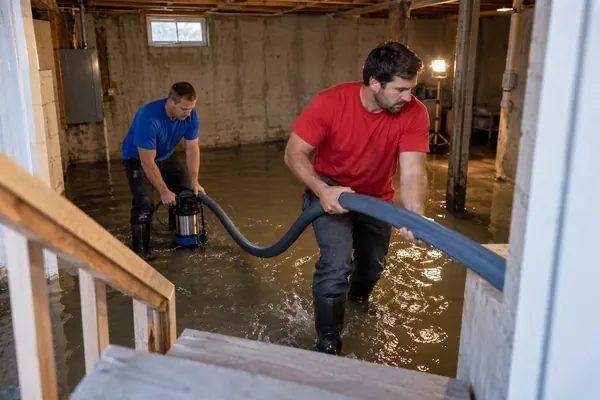
That is the pattern we see after big storms: the water is not coming from a leak or a pipe. It is coming from the street, and it is dirty. Our storm and flash flood damage restoration crew treats it that way, with protective gear, silt removal and a full dry-out.
The ground: sandy plain, packed houses
Elmont is on the outwash plain that spreads south of the North Shore hills, and the soil is mostly sand and gravel with some silt, laid down by meltwater. Left alone, that kind of ground drains well. Water should soak in fast.
The trouble is what has been built on it. Dense housing, paved driveways, roofs and streets cover much of the surface, so rain that would once have soaked in runs off instead and reaches the storm drains all at once. Nassau County uses recharge basins to catch some of that runoff, but in a hard downpour the low points still flood. Houses built on sandy soil also sit in a water table that rises after long rain, and cellar floors can sweat or seep even without street flooding.
Capes, colonials and split-levels
Much of Elmont's housing was built in the middle of the last century: Cape Cods, ranches, colonials and split-levels, many with a full basement. Plenty of owners have finished the lower level, added a bathroom or set up a rental unit. Copper pipes, cast iron drains and original water heaters are all common, and they age at a predictable rate.
Pitched roofs here are better at shedding water than flat ones, but they have their own winter issue. Heat escaping through the attic melts snow on the roof, the melt refreezes at the eave and forms an ice dam, and water backs up under the shingles into the ceiling below. We look for that pattern in the winter months.
The oil tank in the cellar
A lot of Long Island houses still heat with oil, and the tank sits in the cellar. Floodwater can lift an empty or low tank, shift it off its stand or break a fill line, which is a different kind of emergency than water alone. If your tank moved, if you smell oil or if there is a sheen on the floodwater, do not touch it. Call your oil company and the fire department if you smell fuel, then call us.
We handle the water, the wet materials and the drying. We do not clean up oil spills, and we will tell you plainly when a spill needs a specialist before our work can proceed.
Sump pumps, sewer laterals and what gives out
These are the failures that put a crew in an Elmont cellar:
- Sump pumps that fail in a power outage or burn out after years of use
- Downspouts that dump next to the foundation or into a window well
- Sewer laterals that back up in heavy rain or when roots invade old clay joints
- Water heaters and washers in cellar corners that leak for weeks
- Pipes along exterior walls and in unheated garages that freeze in a cold snap
- Basement bathrooms below the level of the sewer main
Winter and the freeze-thaw cycle
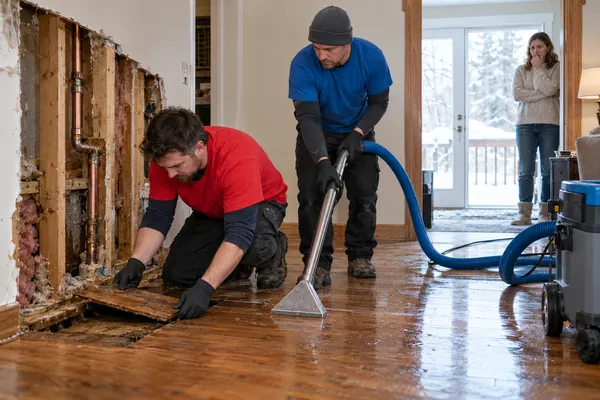
Winter on Long Island means hard freezes followed by quick thaws. Pipes in exterior walls split, a thaw pushes melt toward the foundation and a sump pump discharge line that froze at the outlet sends water back into the pit. Wet snow on a pitched roof can melt and refreeze for weeks.
If you find a split pipe, close the main, open a low faucet and call a plumber for the repair and us for the water. Our frozen and burst pipe cleanup page lays out the work, and our post on thawing a frozen pipe safely explains what to do before anyone arrives.
Insurance and what to ask
Surface flooding and sewer backup are two different things in most policies. A typical homeowners policy does not cover flood, and covers sewer or drain backup only with an endorsement. If your cellar floods from the street, you want to know before the storm whether you have flood coverage. Ask your agent, and keep photos and receipts.
We write down the water line, the materials removed and the readings from each visit, so your adjuster has a clear record.
Rentals, basement apartments and shared houses
Many Elmont houses have a second household in them: an upstairs unit, an in-law apartment or a finished cellar rented to a tenant. When water arrives, it affects two sets of belongings, two sets of expectations and sometimes two insurance policies. A cellar flood is also a safety question, because the lowest unit has the least room to escape.
We talk to the owner and the tenant, set a schedule that works for both and note the damage to each household's property. If a landlord needs documents for a tenant or an insurer, we provide them. Our apartment and multi-unit water damage page has the details.
Mold after a wet cellar
A cellar that stayed wet for a few days after street flooding grows mold on cardboard, paneling, drywall and carpet. In Elmont, where cellars are often finished and carry stored belongings, the growth is often behind a wall before the smell shows up.
We remove the wet material quickly, dry the walls and slab and clean what remains. If mold has started, our mold remediation service handles containment and removal.
Before the next storm: an Elmont checklist
You know the streets that flood. Prepare for them:
- Test the sump pump and keep a battery backup or a spare if you can
- Move stored boxes and valuables off the cellar floor
- Point downspouts away from the house and clear window wells
- Know where your oil tank sits and whether it is secured to its stand
- Keep sandbags or a flood barrier if your driveway slopes toward the garage
- Photograph each room and the mechanical area, and keep copies of your policy
Getting a crew to Elmont
We work from East Elmhurst, a short drive from Elmont along the parkways. When you call, tell us the street, whether the road is passable and where the water is. If the street is flooded, we plan the route and the equipment around it, and we say honestly how long it will take.
Water damage restoration cost in Elmont, NY
These are typical estimates for Nassau County and the New York City area, not guaranteed prices. Contaminated street water and finished cellars cost more. Plumbing repairs and rebuilding are separate. Call for an exact quote.
| Job type | Typical estimate |
|---|---|
| Washer or water heater leak, one room | $1,000–$3,500 |
| Burst pipe affecting two or three rooms | $2,500–$8,500 |
| Cellar flooded by street water | $3,500–$11,000 |
| Sewer lateral backup in a cellar | $4,000–$14,000+ |
| Ice dam ceiling leak and wet insulation | $1,500–$6,000 |
| Mold removal with containment, one area | $2,000–$7,500 |
| Cellar apartment or multi-room flood | $6,000–$18,000 |
Questions we hear in Elmont
Is Elmont street flooding covered by my homeowners policy?
Usually not. Flood is typically a separate policy. Sewer backup needs an endorsement. Ask your agent before the next storm.
What do I do if my oil tank moved?
Stay away, do not use ignition sources and call your oil company. If you smell fuel, call the fire department. We handle the water once it is safe.
How soon can you reach Elmont?
It depends on the roads and the weather. We are based in East Elmhurst, close to Elmont, and we tell you a realistic arrival time when you call.
Can you help with a basement apartment?
Yes. We check exits, electrical and ventilation, and we plan the work with the owner and the tenant.
Will my sump pump stop this?
A working pump with a battery backup helps a lot, but a big storm can still overwhelm one. If water gets in, we clean and dry.
Read next Dry All Year, Flooded in a Thaw: Why Cellars Take On Water.